
Free Hourly Rate Calculator for Australian Freelancers
Introduction
You’re charging $75 per hour. Sounds reasonable, right?
Until you calculate your actual take-home after expenses: superannuation, insurance, software subscriptions, tax, unpaid time (admin, marketing, professional development). Suddenly that $75 becomes $35-40 of actual income.
You’re working full-time but earning part-time wages.
Most Australian freelancers undercharge—not because they undervalue their skills, but because they don’t understand their true costs. They pick a number that “sounds fair” or match competitor rates without knowing if those competitors are profitable.
This guide will teach you how to calculate your real hourly rate: one that covers all your costs, pays you fairly, and builds a sustainable freelance business.
Use our free calculator now: Calculate Your Hourly Rate
Or read on to understand the methodology behind the numbers.
Why Most Freelancers Undercharge
The Mindset Problem
The Employee Mindset:
When you leave a $80,000 salaried job, it’s tempting to divide by working hours and think “$40/hour is fair.”
But that ignores:
-
Your employer paid superannuation (11% on top of salary)
-
They covered sick leave, annual leave, public holidays
-
They provided equipment, software, office space
-
They paid for insurance, accounting, legal costs
-
They handled all business development and admin
As a freelancer, you’re now both the employee AND the employer. You need to cover both sides of the equation.
The Race to the Bottom:
Freelancer marketplaces show competitors at $25-50/hour. You think, “I’ll charge $60 to be competitive.”
But you don’t know:
-
If those competitors are profitable (many aren’t)
-
Where they’re located (cost of living differences)
-
Their experience level (juniors vs. seniors)
-
How many hours they’re actually booking
Pricing based on competitors without knowing your costs is a recipe for burnout and financial stress.
The Hidden Costs
Unpaid Time:
-
Business development and client outreach: 5-10 hours/week
-
Proposals and quoting: 3-5 hours/week
-
Admin and bookkeeping: 3-5 hours/week
-
Professional development: 2-4 hours/week
-
Tools, systems, process improvement: 2-3 hours/week
Average: 15-25 hours per week of UNPAID but essential work.
If you work 40 hours/week but only bill 20-25, your effective hourly rate is half your stated rate.
Ongoing Expenses:
-
Superannuation: 11% of income (required for retirement)
-
Income tax: 21-45% depending on bracket
-
GST: 10% on top of rates (if registered)
-
Professional indemnity insurance: $800-2,500/year
-
Public liability insurance: $400-1,200/year
-
Software and tools: $2,000-5,000/year
-
Accounting and tax: $1,500-3,500/year
-
Marketing and advertising: Variable
-
Office costs: $0-10,000/year depending on setup
These costs add up to 40-60% of your revenue in many cases.
How to Calculate Your True Hourly Rate
The Framework
Your hourly rate needs to cover four things:
-
Your desired take-home income (what you want to actually earn)
-
Business expenses (all the costs of operating)
-
Statutory loadings (superannuation, insurance, on-costs)
-
GST (if registered - added on top for client-facing rate)
Core Formula:
Step 1: Weekly Income Target = Annual Income ÷ Working Weeks

Step 2: Weekly Expenses = Annual Expenses ÷ Working Weeks

Step 3: Weekly Subtotal = Weekly Income + Weekly Expenses

Step 4: Weekly Loadings = Weekly Subtotal × (Super% + Insurance%)

Step 5: Weekly Total = Weekly Subtotal + Weekly Loadings

Step 6: Hourly Rate (ex GST) = Weekly Total ÷ Hours Per Week

Step 7: Hourly Rate (inc GST) = Hourly Rate × 1.1 (if GST registered)
This is the exact methodology used in our calculator above.
Step 1: Define Your Desired Annual Income
What do you want to take home personally (before personal tax)?
Consider:
-
Living expenses (rent, food, utilities, transport)
-
Personal savings goals
-
Debt repayment
-
Lifestyle choices (travel, hobbies, entertainment)
-
Family obligations
Example: $90,000/year take-home
This is YOUR income, not business revenue. Revenue needs to be much higher to deliver this income after business costs.
Step 2: Calculate Business Expenses
Fixed Annual Costs:
| Expense Category | Annual Cost (Example) |
| Superannuation (11% of income) | $9,900 |
| Professional indemnity insurance | $1,500 |
| Public liability insurance | $800 |
| Software subscriptions | $3,000 |
| Accounting and tax services | $2,500 |
| Business registration and licenses | $500 |
| Co-working space or home office | $3,600 |
| Internet and phone | $1,200 |
| Equipment depreciation | $2,000 |
| Professional development | $2,000 |
| Marketing and website | $2,000 |
| Total | $29,000 |
Your expenses will vary, but $20,000-40,000 is typical for Australian freelancers.
Step 3: Estimate Tax Obligations
Income Tax:
Australia’s tax brackets (2024-25):
-
$0-$18,200: 0%
-
$18,201-$45,000: 19%
-
$45,001-$120,000: 32.5%
-
$120,001-$180,000: 37%
-
$180,001+: 45%
Medicare Levy: 2% of taxable income
Example:
If your business generates $150,000 revenue:
-
Income after expenses: $121,000
-
Income tax: ~$31,000
-
Medicare levy: ~$2,400
-
Total tax: ~$33,400
Note: You’ll also collect GST if registered, but this is passed to ATO (not your cost). However, GST registration affects your pricing structure.
Step 4: Calculate Billable Hours
Be realistic about how many hours you’ll actually bill:
Total Hours Available:
- 52 weeks/year × 40 hours = 2,080 hours
Subtract Non-Billable Time:
-
Annual leave: 4 weeks = 160 hours
-
Public holidays: 10 days = 80 hours
-
Sick days: 1-2 weeks = 40-80 hours
-
Professional development: 2 weeks = 80 hours
-
Admin and business development: 10 hrs/week = 520 hours
-
Proposal and quotes (unbilled): 3 hrs/week = 156 hours
Realistic Billable Hours: 1,000-1,200 hours per year
Example: 1,100 billable hours/year = 21 hours per week average
This accounts for real-world realities: client gaps, unpaid work, time off.
Step 5: Apply the Formula
Example Calculation:
Using the weekly calculation method (matching our calculator):
Annual income goal: $90,000

Annual expenses: $29,000

Working weeks: 48 (52 - 4 vacation)

Hours per week: 30

Super loading: 11%

Insurance loading: 3%

GST registered: Yes


Step 1: Weekly income target = $90,000 ÷ 48 = $1,875

Step 2: Weekly expenses = $29,000 ÷ 48 = $604

Step 3: Weekly subtotal = $1,875 + $604 = $2,479

Step 4: Weekly loadings = $2,479 × 14% = $347

Step 5: Weekly total = $2,479 + $347 = $2,826

Step 6: Hourly rate (ex GST) = $2,826 ÷ 30 = $94.20

Step 7: Hourly rate (inc GST) = $94.20 × 1.1 = $103.62
Round to: $105/hour (inc GST) or $95/hour (ex GST)
This is your MINIMUM rate to achieve your income goal sustainably. Note that taxes are paid on your personal income, not built into your hourly rate calculation.
Australian Business Cost Considerations
Superannuation
As a sole trader, you’re not required to pay yourself super, but you should.
Why:
-
Builds retirement savings (you have no employer contributing)
-
Tax deductible (reduces taxable income)
-
Concessional tax rate (15% vs your marginal rate)
How Much:
Minimum 11% of your income (matching employer standard)
Example:
$90,000 income × 11% = $9,900/year super contribution
ABN and Business Registration
Australian Business Number (ABN): Free to register via business.gov.au
Required for:
-
Invoicing without tax withheld
-
GST registration
-
Business name registration
Costs:
-
ABN: Free
-
Business name (optional): $37 for 1 year, $87 for 3 years
GST Registration
Threshold: Required if earning $75,000+ annually (optional below)
How it works:
-
Charge clients 10% GST on top of your rate
-
Collect and remit to ATO quarterly
-
Claim GST credits on business expenses
Impact on Pricing:
Option 1: GST-inclusive pricing
-
Quote $165/hour (includes $15 GST)
-
You keep $150, remit $15 to ATO
Option 2: GST-exclusive pricing (recommended for B2B)
-
Quote $150/hour + GST = $165/hour total
-
Clients with ABN can claim GST back
-
Clearer separation of your rate vs. tax
Insurance Requirements
Professional Indemnity Insurance:
Covers claims of negligent advice or errors in your work
-
Cost: $800-2,500/year depending on revenue and industry
-
Recommended for: Consultants, designers, developers, strategists
-
Coverage: $1M-$5M typical
Public Liability Insurance:
Covers injury or property damage claims
-
Cost: $400-1,200/year
-
Recommended for: Anyone meeting clients in person or working on-site
-
Coverage: $10M-$20M typical
Tax Planning
Quarterly Tax Obligations:
-
PAYG instalments (prepaying income tax)
-
GST returns (if registered)
-
Superannuation contributions (if you have employees or pay yourself)
Annual Obligations:
-
Tax return (individual)
-
Business Activity Statement
-
Payment summaries
Deductible Expenses:
-
Home office costs (percentage of rent, utilities)
-
Equipment and software
-
Professional development
-
Travel for work purposes
-
Insurance premiums
-
Accounting fees
Work with an accountant to maximize deductions legally.
Use Our Free Hourly Rate Calculator
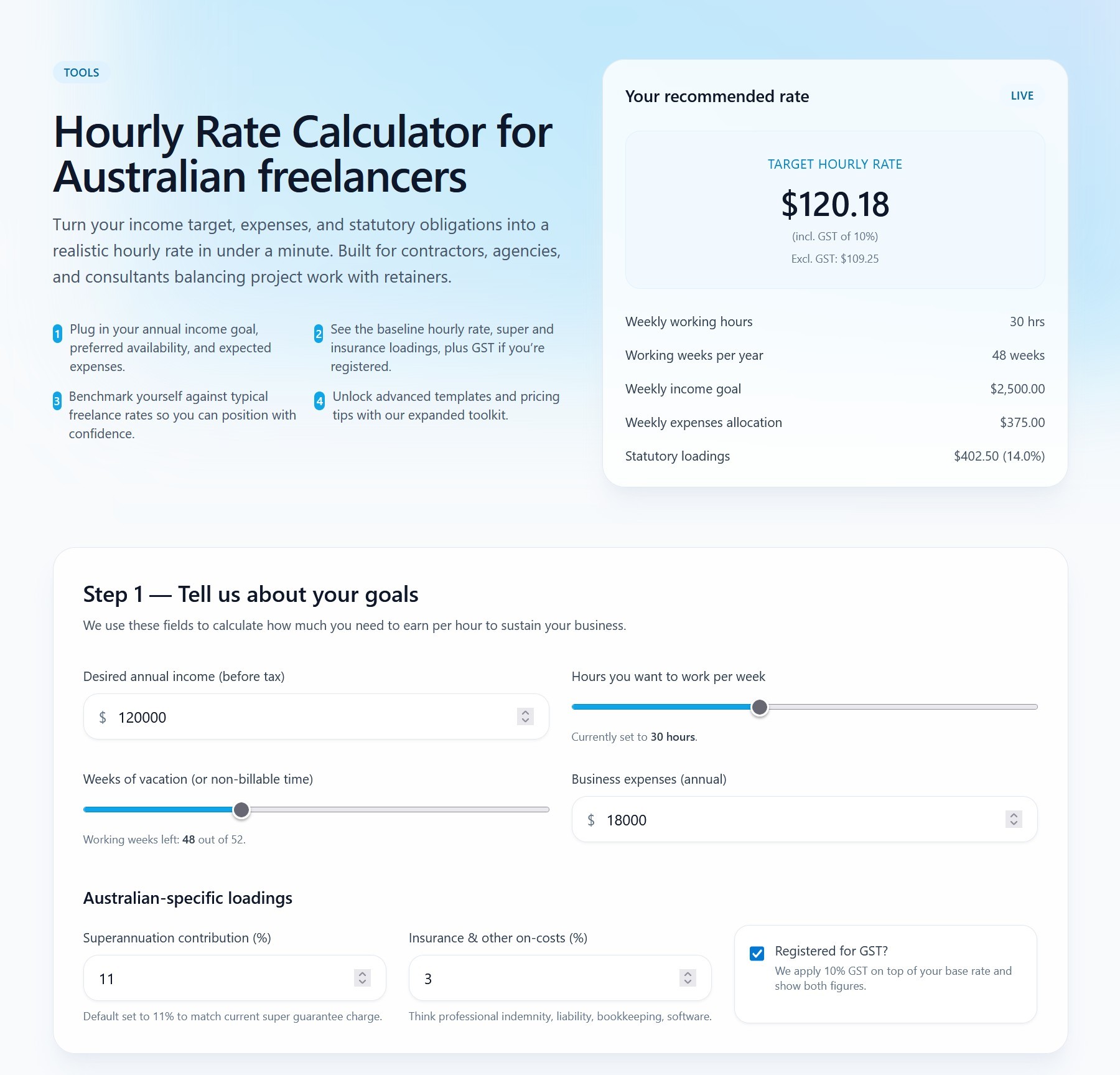
We’ve built an interactive calculator specifically for Australian freelancers that does all the math for you in real-time.
What the Calculator Includes:
Smart Input Fields:
-
Desired annual income (before tax)
-
Hours you want to work per week (adjustable slider)
-
Weeks of vacation/non-billable time per year
-
Annual business expenses
-
Australian-specific loadings:
-
Superannuation contribution percentage (default 11%)
-
Insurance and other on-costs percentage
-
GST registration toggle
Live Results:
-
Your recommended hourly rate (displayed prominently with GST breakdown)
-
Weekly income goal and expense allocation
-
Statutory loadings breakdown
-
Working weeks per year calculation
Detailed Breakdown:
See exactly where your rate comes from:
-
Income target (weekly)
-
Business expenses (weekly)
-
Super & insurance loadings
-
GST component (if applicable)
Industry Benchmarks:
Compare your calculated rate against typical Australian freelancer rates:
-
Entry freelancer (AU): $110/hr
-
Established consultant: $160/hr
-
Specialist agency: $210/hr
Bonus Resources:
Enter your email to receive:
-
Advanced expense template (Google Sheets + CSV)
-
Rate positioning guide with pricing scripts
-
Client email templates for rate increases
Industry Benchmark Rates (Australia 2025)
Quick Reference Benchmarks
Based on our calculator’s built-in comparisons, here are typical Australian freelance rates:
General Freelancer Categories:
-
Entry freelancer (AU): ~$110/hour
-
Established consultant: ~$160/hour
-
Specialist agency: ~$210/hour
These align with the benchmarks shown in our calculator for easy comparison.
Detailed Service Rates
Creative Services:
| Service | Entry/Mid | Established | Specialist |
| Graphic Design | $80-120 | $120-180 | $180-300 |
| Copywriting | $90-130 | $130-200 | $200-350 |
| Web Design | $100-140 | $140-200 | $200-400 |
| Video Production | $100-150 | $150-250 | $250-500 |
| Photography | $110-180 | $180-300 | $300-600 |
Tech and Development:
| Service | Entry/Mid | Established | Specialist |
| Web Development | $90-130 | $130-200 | $200-350 |
| Mobile App Development | $110-150 | $150-220 | $220-400 |
| DevOps/Infrastructure | $120-180 | $180-280 | $280-450 |
| Data Science | $130-200 | $200-300 | $300-500 |
| Security/Pen Testing | $150-220 | $220-350 | $350-600 |
Consulting and Strategy:
| Service | Entry/Mid | Established | Specialist |
| Business Strategy | $120-180 | $180-300 | $300-600 |
| Marketing Consulting | $110-160 | $160-250 | $250-450 |
| HR Consulting | $110-170 | $170-260 | $260-400 |
| Financial Consulting | $130-200 | $200-320 | $320-550 |
| Management Consulting | $150-220 | $220-350 | $350-650 |
Important Notes:
-
All rates shown are GST-exclusive for B2B work
-
Sydney/Melbourne rates typically 15-25% higher than regional areas
-
Industry specialization (fintech, healthcare, legal) commands 20-40% premium
-
Retainer/package rates often 10-15% higher than project rates
Use our calculator to see how your rate compares: Calculate Your Rate
How to Raise Your Rates Without Losing Clients
Timing
Best Times:
-
When taking on new clients (easiest)
-
Annual rate review (predictable, professional)
-
After completing successful project (demonstrated value)
-
When adding new services or skills (justified increase)
Avoid:
-
Mid-project (unless scope changed)
-
During client financial difficulties
-
Without warning or explanation
Communication
For New Clients:
Simply present your current rates. No explanation needed.
For Existing Clients (Annual Increase):
Email Template:
Subject: 2025 Rate Update

Hi [Name],

I wanted to give you advance notice that I'll be adjusting my rates effective [date, at least 30 days out].

My new rate will be [new rate], up from [old rate].

This increase reflects:

- [Reason 1: inflation, increased expertise, additional services]

- [Reason 2: market positioning, demand, specialization]

I truly value our working relationship and wanted to give you plenty of notice.

If you have any questions or concerns, I'm happy to discuss.

Thanks for your continued partnership.

Best,

[Your name]
For Value-Based Increase:
When you’ve demonstrably improved results or added significant value:
“Based on the results we’ve achieved together ([specific outcomes]), I’m adjusting my rates to reflect the value I’m delivering. My new rate is [X], effective [date].”
Managing Pushback
If client objects:
-
Acknowledge: “I understand this is an increase.”
-
Justify: “My rates reflect the value I deliver and my market positioning.”
-
Offer transition: “I can honor the old rate for projects booked by [date].”
-
Stand firm: “This is my professional rate. I’m confident in the value I provide.”
If they threaten to leave:
Let them. Clients who only value price are not sustainable long-term relationships. Your time is better spent finding clients who value your expertise.
When to Switch from Hourly to Value Pricing
Hourly rates work well early in your freelance career, but they have limitations:
Problems with Hourly:
-
Penalizes efficiency (faster work = less money)
-
Caps your earning potential
-
Makes clients watch the clock
-
Commoditizes your expertise
When to Switch:
-
You can clearly articulate value delivered (not just time spent)
-
Clients care more about outcomes than inputs
-
You’ve productized your services (repeatable process)
-
You’re confident in scoping and pricing projects
Value Pricing Examples:
-
Website redesign: $15,000 (regardless of time)
-
Brand strategy package: $25,000 (3-month engagement)
-
Marketing audit and plan: $8,000 (1-month project)
Value pricing requires confidence and client education, but it can dramatically increase your income without working more hours.
Not sure where to start? Use our calculator to establish a solid hourly baseline: Calculate Your Rate
Track Your Profitable Hours
Knowing your rate is step one. Actually earning it requires tracking:
What to Monitor:
-
Billable vs. non-billable hours
-
Actual time spent vs. estimated
-
Which clients are most profitable
-
Which services command best rates
Why It Matters:
-
Identifies unprofitable clients or services
-
Improves future estimating
-
Proves you’re hitting income targets
-
Informs rate adjustment decisions
ChronoFlow for Freelancers
Built specifically for freelancers and consultants selling their time:
Track billable hours effortlessly
-
Simple start/stop timers
-
Automatic categorization
-
Mobile and desktop tracking
Monitor profitability in real-time
-
See if you’re on track for income goals
-
Compare actual vs. estimated hours
-
Identify most profitable clients
Manage hour packages and retainers
-
Create client hour packages
-
Automatic balance deductions
-
Proactive alerts when hours running low
-
Client portal for transparency
Try ChronoFlow free for 14 days: chronoflow.com.au
Conclusion
Calculating your true hourly rate isn’t about picking a number that sounds fair. It’s about understanding your costs, valuing your time realistically, and building a sustainable freelance business.
Most Australian freelancers undercharge because they don’t account for:
-
Unpaid time (admin, business development, professional growth)
-
Business expenses (super, insurance, software, accounting)
-
Statutory loadings (superannuation, insurance on-costs)
-
GST registration and compliance
Use the framework in this guide:
-
Define your desired take-home income
-
Calculate all business expenses
-
Apply statutory loadings (super, insurance)
-
Determine realistic billable hours
-
Apply the weekly calculation formula
-
Add GST if registered
The easiest way? Use our free calculator: Calculate Your Hourly Rate
The result is a rate that sustains your business and pays you fairly for your expertise.
Don’t race to the bottom. Charge what you’re worth. Build the freelance career you deserve.
About ChronoFlow: Time tracking and profitability software for Australian freelancers and consultants. Track billable hours, manage client packages, and stay profitable with automated budget alerts.
Learn more: chronoflow.com.au
Related articles
ChronoFlow vs Harvest vs Toggl: Which Time-Tracking Tool is Right for Your Team?
Time trackers answer how long work took. They don’t answer whether the work should have been done.
The Complete Guide to Preventing Scope Creep with Automated Budget Alerts
Stop scope creep before it kills your profit. Learn how automated budget alerts prevent project overruns with this compl...
Hour Packages vs Traditional Billing: A Complete Guide for Consultants
Learn how hour packages work and why consultants are switching from hourly billing. Complete guide with pricing strategi...